Building
Mechanisms, levers, bridges and power
A lever on a wall and a length of hidden linkage can open a door three levels away, drain a lake or raise the only bridge between your fortress and an army. Mechanisms are where a fortress starts to feel like a machine.
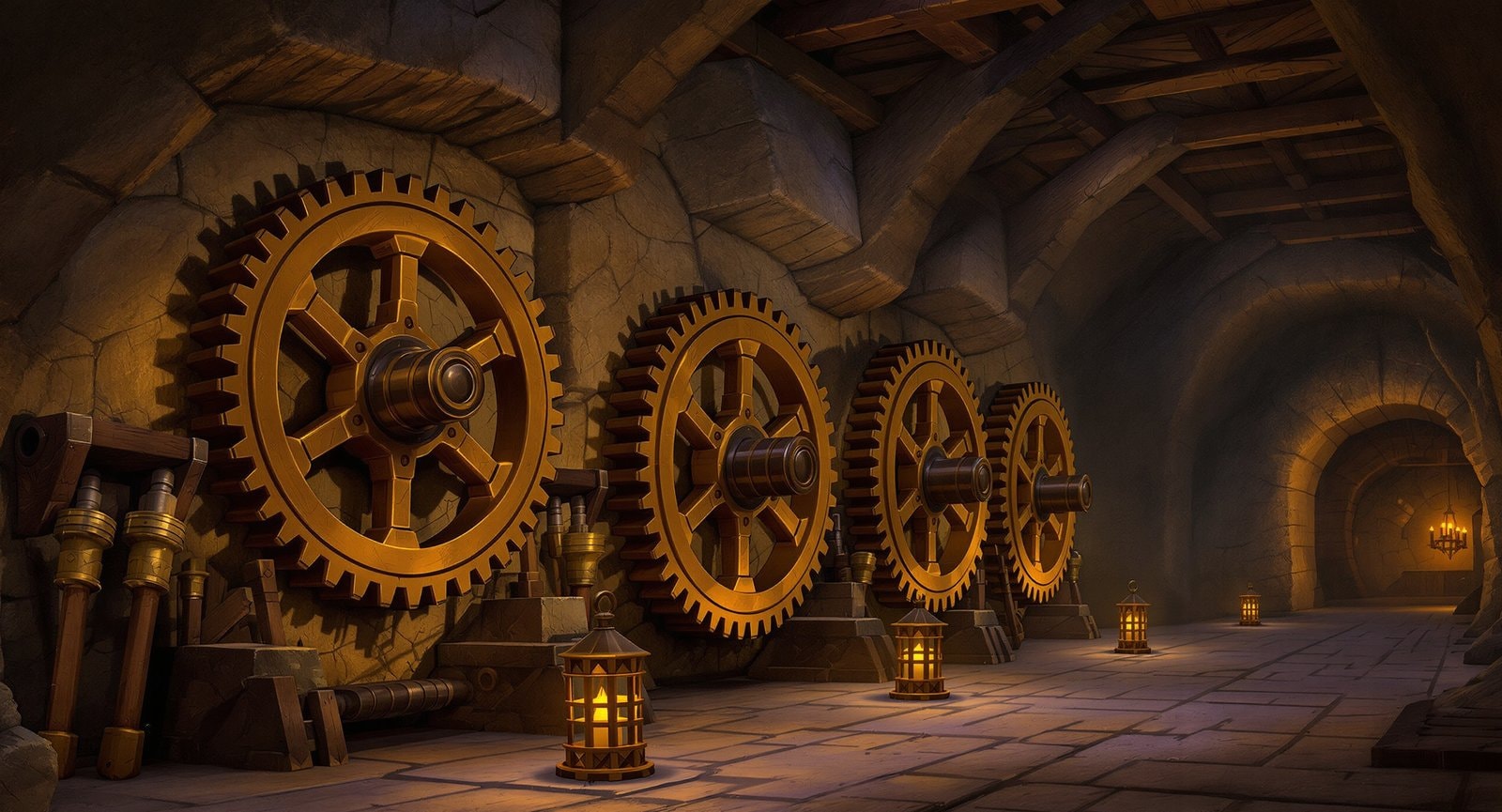
Most of what dwarves do is dig, carry and make things. A small but essential group of jobs is about making things move: bridges that rise, floodgates that open, doors that lock when you say so, and machines that turn with the power of flowing water. All of it runs through one kind of object, the mechanism, and one kind of worker, the mechanic.
The mechanic
The official wiki's page on the mechanic describes the skill as covering the making of mechanisms, in either the mechanic's own workshop or at a metalsmith's forge, the placing of buildings that need them, such as levers, gears and traps, and the linking of levers or pressure plates to things like bridges and floodgates. It also notes that a skilled mechanic makes better mechanisms and links things up faster than a novice. In a new fortress, it is worth having one dwarf who does this regularly, because linking jobs tend to arrive in a hurry at exactly the moment you need them done.
Mechanisms themselves are small, cheap to make from stone, and needed in surprising quantities. Every link between a lever and the thing it controls uses them, as do traps and many machines. Keeping a small stock ready saves you from discovering, mid-siege, that the drawbridge cannot be connected because nobody made the parts.
Levers, plates and links
A lever is a switch. When a dwarf pulls it, everything linked to it changes state: a door locks or unlocks, a bridge rises or lowers, a floodgate opens or closes. A pressure plate does the same thing, but automatically, when something steps on it or when water or magma reaches it. You decide what triggers a plate: creatures of a certain size, your own citizens, or a depth of fluid.
Links are invisible once made, so it is easy to forget which lever does what. Good habits help. Keep all your important levers together in a single, secure control room near the heart of the fortress. Place them in a sensible order and remember it, or keep a note. A lever that raises the outer bridge and a lever that floods the lower cellars should not be next to each other with nothing to tell them apart.
Bridges, doors, floodgates and hatches
These are the everyday outputs. Doors and hatches can be locked by linking them to a lever, turning any corridor into a sealable one. Floodgates control water and magma, and are the main tool for managing both; the water page covers them in detail. Bridges are the most versatile. A bridge can be raised to form a wall, lowered to form a floor, or, in some designs, used to deal with whatever is standing on it at the time, which is why cautious overseers keep dwarves well away from bridges during testing.
Drawbridges as defence
The single most useful defensive structure for a new fortress is a raising bridge across the entrance. When it is lowered, traders and migrants come and go. When it is raised, the fortress is sealed. Link it to a lever deep inside, assign someone to pull it, and you have a way to shut the door on almost any threat that does not dig or fly. The military and defence page builds on this with walls, trap corridors and a real army.
One rule prevents a lot of tragedy: know where your own dwarves are before you pull the lever. A bridge raised with a hauler halfway across has been the end of more than one favourite miner.
Power: wheels, windmills and gears
Some buildings, like a mill that grinds plants or a pump that lifts water, can be operated by hand or driven by machine power. Machine power comes mainly from water wheels, which turn in flowing water, and windmills, which turn in the wind. Power travels from its source along axles and through gear assemblies to whatever needs it.
The idea is borrowed from the real world. Wikipedia's article on the water wheel describes it as a machine that turns the energy of flowing or falling water into useful power, and lists real uses such as milling flour, hammering wrought iron, crushing ore and preparing fibre for cloth. It also explains that real wheels were usually fed from a mill pond made by damming a stream, with a channel carrying water to the wheel and another carrying it away. Dwarven engineers solve the same problem underground: steady flowing water, arranged so it keeps moving past the wheel.
The simplest useful power system is a water wheel on a flowing river or channel, a line of axles, and a single pump or millstone at the end. From there players build elaborate networks: whole pump stacks lifting water many levels, gear assemblies switched on and off by levers, and self-sustaining loops that are the pride of their builders.
Traps, briefly
Mechanisms are also the heart of traps. A trap is a building that reacts to a creature stepping on it, with results ranging from a closed cage to something considerably worse. Traps are covered alongside the rest of the fortress's defences on the military page.
When machines become logic
Once you have levers, plates, gears and floodgates all linked together, you are only a small step from making them respond to each other. A plate that senses rising water can close a floodgate. A gear that turns can drive a pump that trips a plate. Players who follow that thread all the way end up building working logic circuits, described on the dwarven computing page.
A short checklist
- Train at least one mechanic early, and keep a few mechanisms in stock.
- Put a raising bridge across the main entrance, linked to a lever inside.
- Keep levers together in a secure room, and know what each one does.
- Test bridges and floodgates when nobody is standing near them.
- Start with one water wheel driving one machine before building anything grand.