Building
Megaprojects and grand constructions
Once a fortress can feed itself and keep its enemies outside, a certain kind of player looks at the mountain and wonders how much of it could be rearranged.
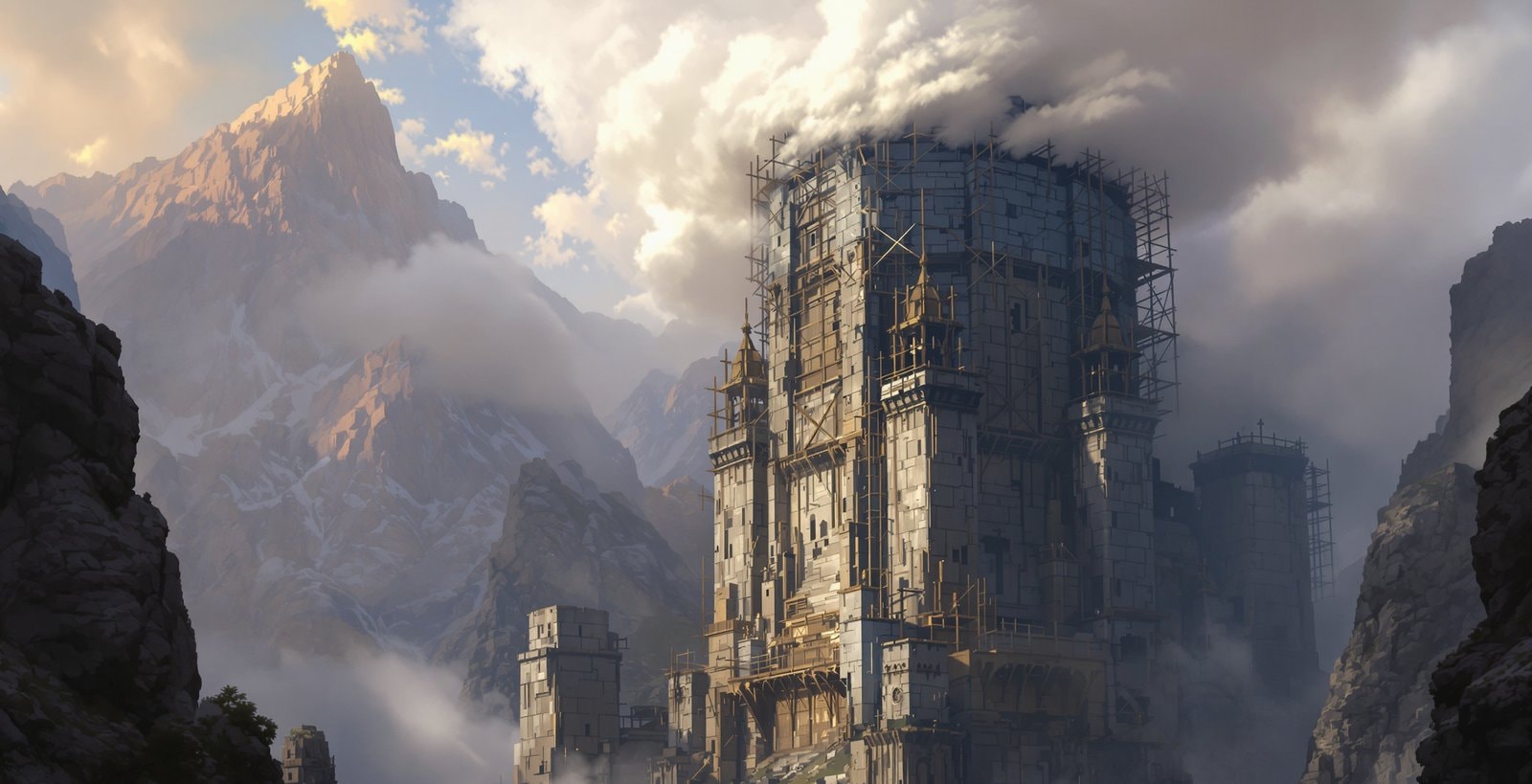
The game sets no goals, so players set their own. For many, the ultimate goal is to build something enormous: a tower that reaches the sky, a wall around a whole valley, a hall carved to impossible dimensions, a mountain hollowed out and refilled in a more pleasing shape. The official wiki's megaproject page defines the term simply as any construction that needs a very long time to finish, and adds that impressive feats of construction are usually very fun. That gentle understatement covers some of the most ambitious things anyone has done in a game.
What counts as a megaproject
There is no formal definition beyond size and time. A megaproject is something that consumes years of in-game effort, a large share of your workforce and a great deal of material, and exists mainly because you wanted it to. Some are useful. Many are not. All are a statement.
Some of the classic kinds:
- Towers
- Structures rising far above the surface, built block by block from the ground up, often hollow and filled with rooms. Towers are a natural first megaproject because they grow visibly and can be stopped at any height.
- Walls and enclosures
- A wall around the fortress entrance, then around the surface fields, then around the whole map. Walls are useful for defence and deeply satisfying to finish.
- Great halls
- Enormous chambers carved out of solid rock, smoothed and engraved from floor to ceiling, supported by pillars. They are a way to make the fortress feel like the grand dwarven halls of legend.
- Reshaping the landscape
- Levelling a hill, filling a valley, diverting a river, draining a lake, or carving the outline of something into the mountainside. These projects show off an understanding of digging and fluid behaviour.
- Aqueducts and waterworks
- Carrying water across the map on raised channels, feeding cisterns, fountains and farms. Beautiful and practical, when they work.
Obsidian casting
One of the most famous megaproject techniques uses the reaction between magma and water. When they meet, they form obsidian. By carefully controlling where each flows, players can "cast" solid obsidian in the shape they want: walls, towers, whole buildings formed not by masons but by fluids. The official page describes casting as creating a giant structure out of natural obsidian through an elaborate scaffold of magma pools, water pools and pumps. It is spectacular, and it combines everything difficult about the game at once: magma safety, pressure, pump stacks and timing. The magma and water pages cover the pieces.
The dwarven atom smasher
The "dwarven atom smasher" is a player term for a device built from a bridge, not for anything scientific. In the game, a bridge being raised or lowered can destroy whatever is in its way. Players realised that this could be used, deliberately, as a disposal system: move unwanted objects, or unwanted visitors, onto a bridge and operate it. The name is a joke about the result. It is less a building project than an example of the same spirit, taking a game mechanic and pushing it to a logical extreme. The mechanisms and power page explains bridges in their more ordinary role.
Computers and machines
Some megaprojects are not buildings at all but machines. Players have built working logic circuits, calculators and clocks from levers, pressure plates, water and animals. They take enormous planning and patience, and they belong on the list for exactly that reason. The dwarven computing page covers them.
Why players spend years on them
Part of the answer is simply that the game allows it. A world where you can reshape a mountain, one block at a time, invites you to try. Part of it is that megaprojects give a mature fortress a purpose. Once food, drink, housing and defence are solved, the daily routine can become quiet; a grand project gives every miner, mason and mechanic something to do and gives you something to look forward to.
And part of it is storytelling. A fortress remembered for its tower, its wall or its obsidian cathedral has an identity. When it eventually falls, as all fortresses do, what it built is often the part players remember and share. The spirit is close to that of the self-imposed rules on the stories and challenges page.
Planning one without ruining the fortress
- Secure the basics first. A megaproject that starves the farms of workers, or leaves the entrance open during a siege, will end the fortress before it ends the project.
- Stockpile materials in advance. Large builds consume vast amounts of stone, blocks or metal. Having them ready keeps the project moving.
- Build in stages. Choose a design that looks finished at several points along the way, so you are not left with a useless half.
- Test risky mechanisms small. Anything involving magma, large volumes of water or bridges should be tried on a small scale before the big version.
- Mind the framerate. Huge structures, long fluid flows and many construction items can slow the game. The performance page has habits that help.
Start with something modest
A good first megaproject is a small tower or a great hall. Both teach planning, material logistics and patience without risking the fortress. When that is done, you will have your own ideas about what comes next, and they will probably be larger.